Honduras. Hurricanes and Helping Hands.

Updated: Jun 17, 2025
The 2020 disaster season seems to have no end. I returned from two weeks in Honduras with a Team Rubicon WASH program on December 6th feeling exhausted yet hopeful.

Honduras suffered back-to-back hurricanes in November (Eta and Iota) that ravaged areas of the north coast and created a humanitarian crisis. Many mountain villages were cut off from supplies and the flooding contaminated water sources. Being largely agricultural areas, the flooding and wind damage destroyed the years crops as well. This was catastrophic on multiple levels. It left them no sustained food source for the coming months. It destroyed their economic life. And it ruined the seeds needed to plant for the next season.
Team Rubicon put together an operation to deliver water systems to those communities and deployed a small team in mid-November. Not knowing what to expect upon arrival, the team quickly adapted to conditions on the ground in a couple key ways. First, a partnership with ADRA was formed enabling them to identify and move to impacted areas that would benefit from clean water solutions. Second, they were able to shift the delivery model from direct home-to-home engagement to training local groups and clinic workers to more effectively distribute aid quickly. This proved critical given the short timeframe allotted for the operation.

From the mountainous jungle villages along the Cangrejal River like Las Mangas, El Pital, Herradura, and Rio Viejo to the coastal Garifuna fishing village of Triunfa de la Cruz. The team let nothing stop them. Not the torrential rains washing hills sides on to the road. Not the river that had cut off the road to the most remote villages (TR team members commandeered a front-end loader and driver to fill in the deepest areas of the river allowing much needed supplies to be transported to the other side). Not the challenges of simply getting supplies into the country. It was a no-nonsense group of volunteers.

There were also deep personal connections to Honduras for a couple of the team members. One who had lived in nearby Tela, and opened a clinic serving the local community as well as the close by Garifuna village, and had a deep bond with a family there. Another who had spent his younger years in Honduras and other Central American countries and would later work as a Forensic Anthropologist helping to exhume and identify victims of the region’s violence for many years.
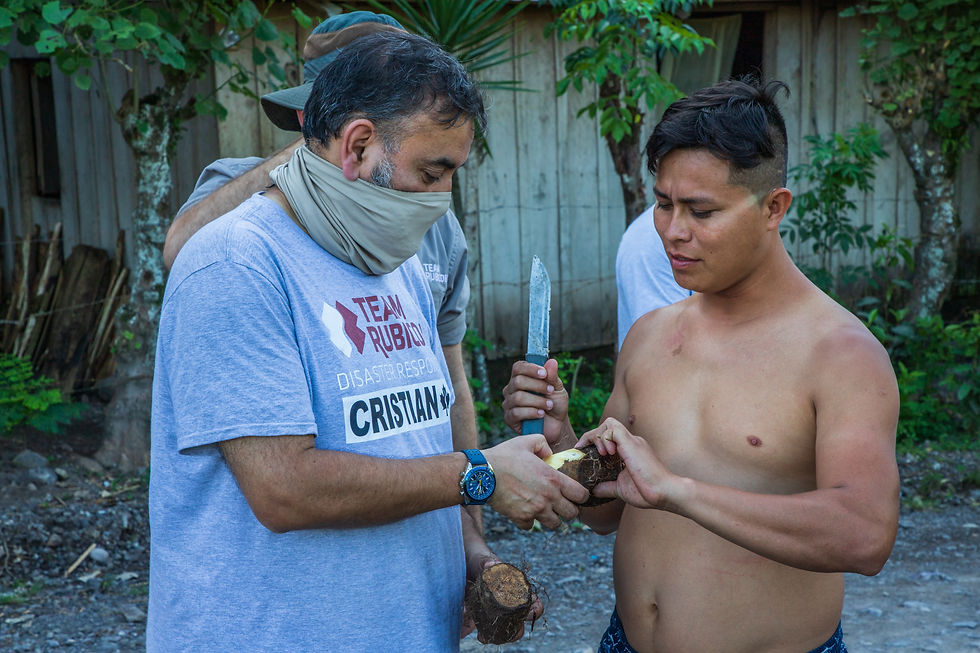
In true Team Rubicon fashion, most of them had never met prior to landing in Tegucigalpa. The ability of these volunteers to gel quickly, formulate a plan of execution, and achieve immediate impact was paralleled only by the deep personal friendships that were developed along the way.
In the end Team Rubicon, in partnership with ADRA and Dr. Melvin Pacheco's Las Mangas clinic, were able to deliver 500 filtration systems that will provide clean water to families in need for up to two years. If this small group of volunteers can have an impact that significant in that short of time, just think what could be done if we all contributed just a little.

Comments